

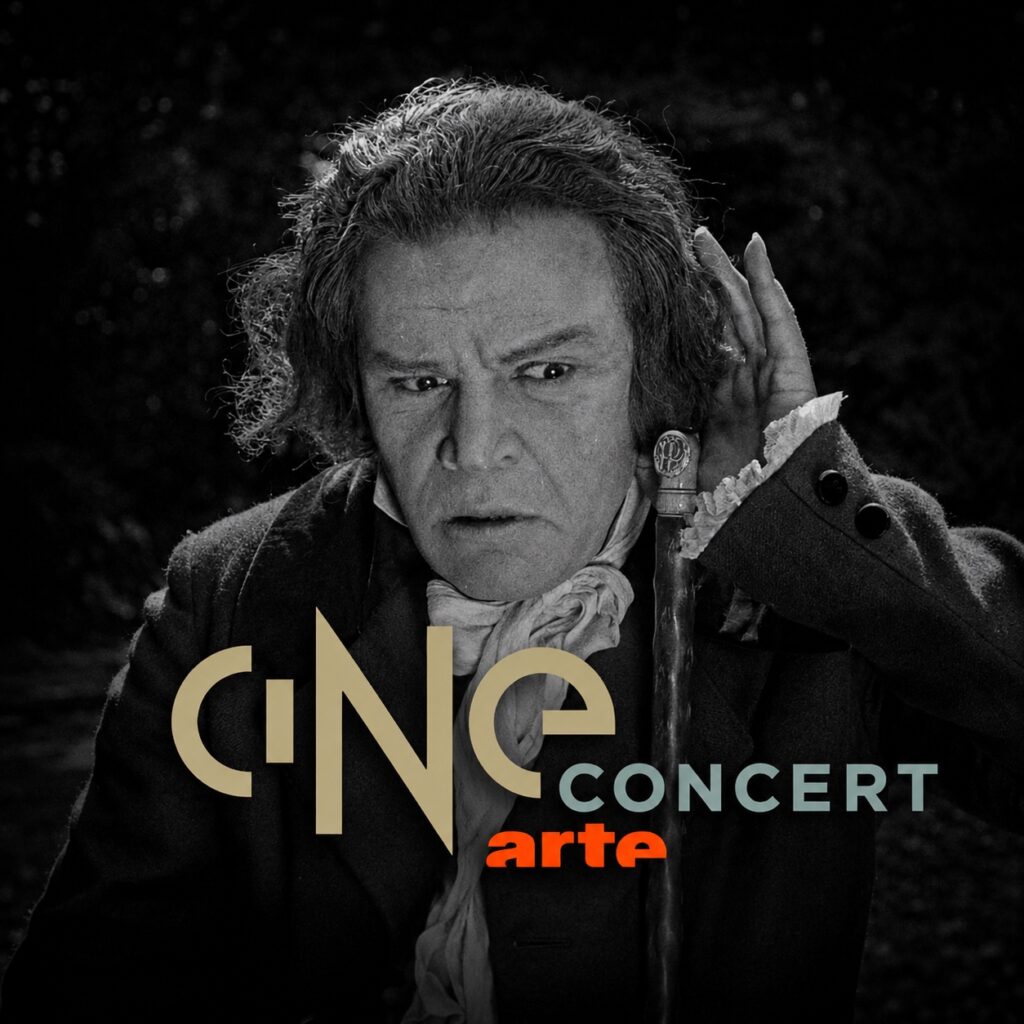
Hans Otto Löwenstein
1927
Written by Emil Kolberg
Malte Giesen
2020
3 Flute (3.Picc).2 Reed.2 Clarinet.2 Bassoon (3.ContraBassoon) – 4 Horn.2 Trumpet.3 Trombone.0
– Timpani.2 Percussion.Piano (also Toy-Piano)
– Strings (10.8.6.5.4)
Perc 1: snare drum, suspended cymbal, hand cymbal, tam-tam, rattle, crotales, tubular bells, singing saw, triangle
Perc 2: bass drum, suspended cymbal, glockenspiel, 4 woodblocks (very high, high, medium, low), windchimes, triangle, crotales, 2 styrofoam blocks
Solo piano, Toy-Piano with 33 Tasten
Amplification for piano, toy piano, 1st violin, 1st cello; reverb effect on piano;
2-channel audio playback embedded in the film file
[71 minutes]
Nina Goslar (ZDF)
The restored version comes from the Filmarchiv Austria and is the French export version, which also quotes Romain Rolland in its text form, who had a significant influence on the French reception of Beethoven. This French version, shortened by 10 minutes, is the oneThe restored version comes from the Filmarchiv Austria and is the French export version, which also quotes Romain Rolland in its text form, who had a significant influence on the French reception of Beethoven. This French version, shortened by 10 minutes, is the only surviving version of the film. The lost original version with the subtitle ‘In commemoration of the 100th anniversary of the death of the singer of eternity’ had a length of 80 minutes and went into more detail about the works of the major creative phase (5th and 9th symphonies). As the comparison with the preserved German admission card shows, there was still a sequence in the original version about the later years, shaken by strong biographical crises, in which, among other things, the Fateful Symphony was written. Another excursus dealt with the dungeon scene from Fidelio, a quasi visualisation of the composer’s life situation and his increasing deafness.
The new musical version by the multi-award-winning composer Malte Giesen (*1988) quotes all the Beethoven works mentioned in the film and processes them in an original arrangement for small orchestra that oscillates between cinema pop and art music. The composer writes about his music: «The idea is to develop a kind of ‘composed interpretation’ from Beethoven works that musically accompanies the film in ever-changing functions. I want to work with techniques that are directly linked to the contemporary aesthetics and philosophy of my generation: remix, sampling, shuffling, even the mix of orchestra/electronics should be used here. In this way, I ask myself the hypothetical question: How would Beethoven have composed if electronics had already existed? So electronics are used in different functions, on the one hand as an additional timbre with its own aesthetic and on the other hand as a conscious playing with the «media colour» and historicity of electronic sounds (as through gramophone, record, playing with clichéd silent film music aesthetics).
– 2027.June.18 / BILBAO ORKESTRA SINFONIKOA, Teatro Arriaga (BIlbao) [SPANISH PREMIERE]
